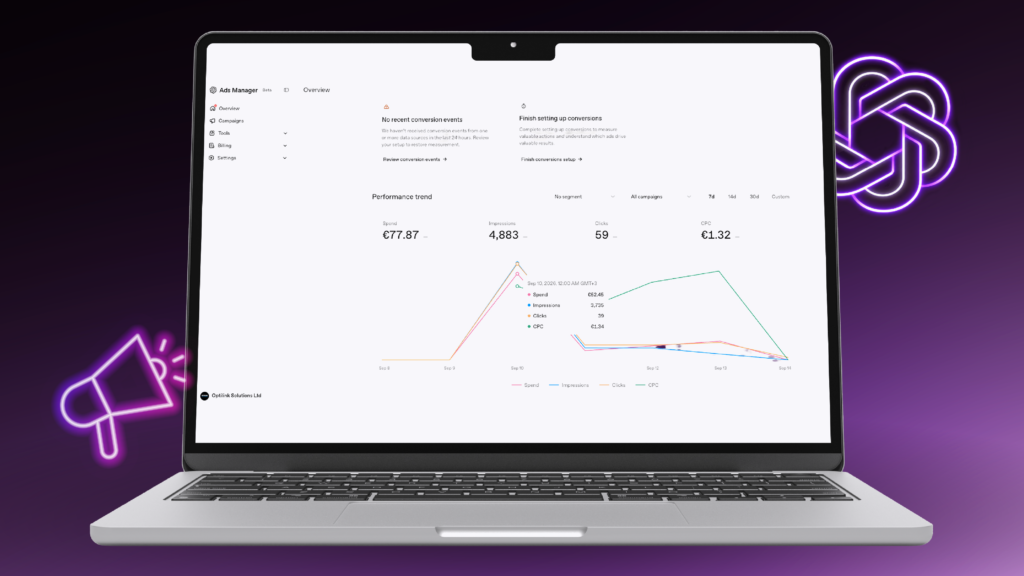
ChatGPT advertising has officially entered a new stage and at OS3 Digital, we’ve started testing it ourselves.
Following the expansion of ChatGPT Ads across Europe and the launch of self-service access through OpenAI Ads Manager Beta, we launched our first test campaign targeting Cyprus.
Rather than simply talking about what ChatGPT Ads could mean for advertisers, we wanted to understand the platform first-hand: how campaigns are created, what targeting options are available, how conversion tracking works and, most importantly, what the early performance looks like.
And we already have our first results.
Our First ChatGPT Ads Results
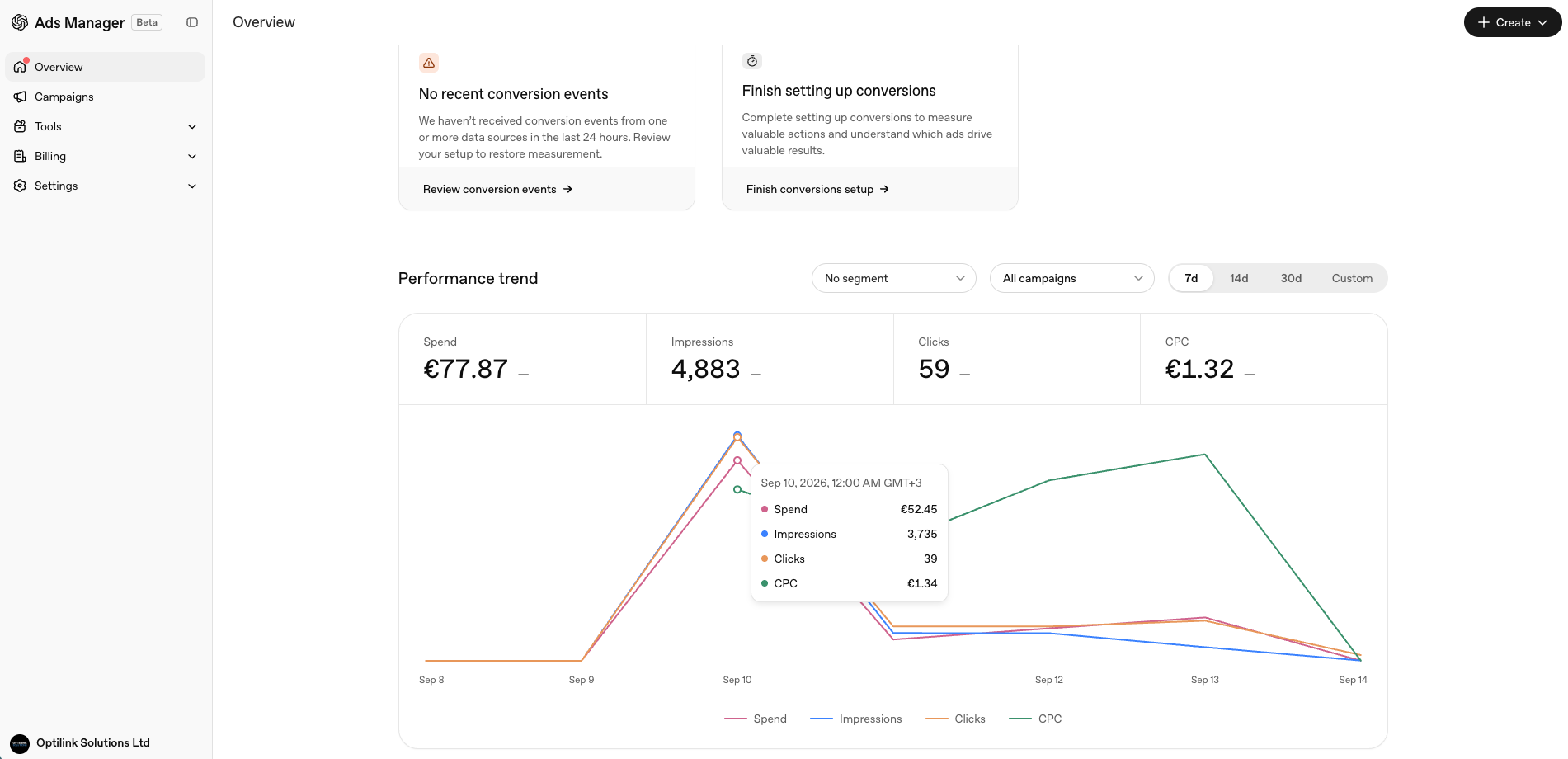
During the initial testing period, our campaign generated:
4,883 Impressions
59 Clicks
€77.87 Spend
€1.32 Average CPC
These are still very early results from a limited test campaign, so they shouldn’t be treated as a benchmark for ChatGPT advertising in Cyprus.
But they give us something considerably more useful: real data to start learning from.
What Does OpenAI Ads Manager Look Like?
If you’ve worked with Google Ads or Meta Ads Manager, parts of the structure will feel familiar.
OpenAI Ads Manager Beta allows advertisers to create campaigns, control budgets, select locations and platforms, configure conversion events and monitor performance from a central dashboard. OpenAI currently supports objectives based around impressions, clicks and conversion optimisation.
Campaigns are organised into three levels:
Campaign → Ad Group → Ad
The campaign controls the overall objective, budget, dates and targeting. Ad groups organise ads around particular themes or intent areas, while the individual ad contains the creative, copy and destination.
For our test, we were able to target Cyprus directly and configure the campaign around our selected objective and budget.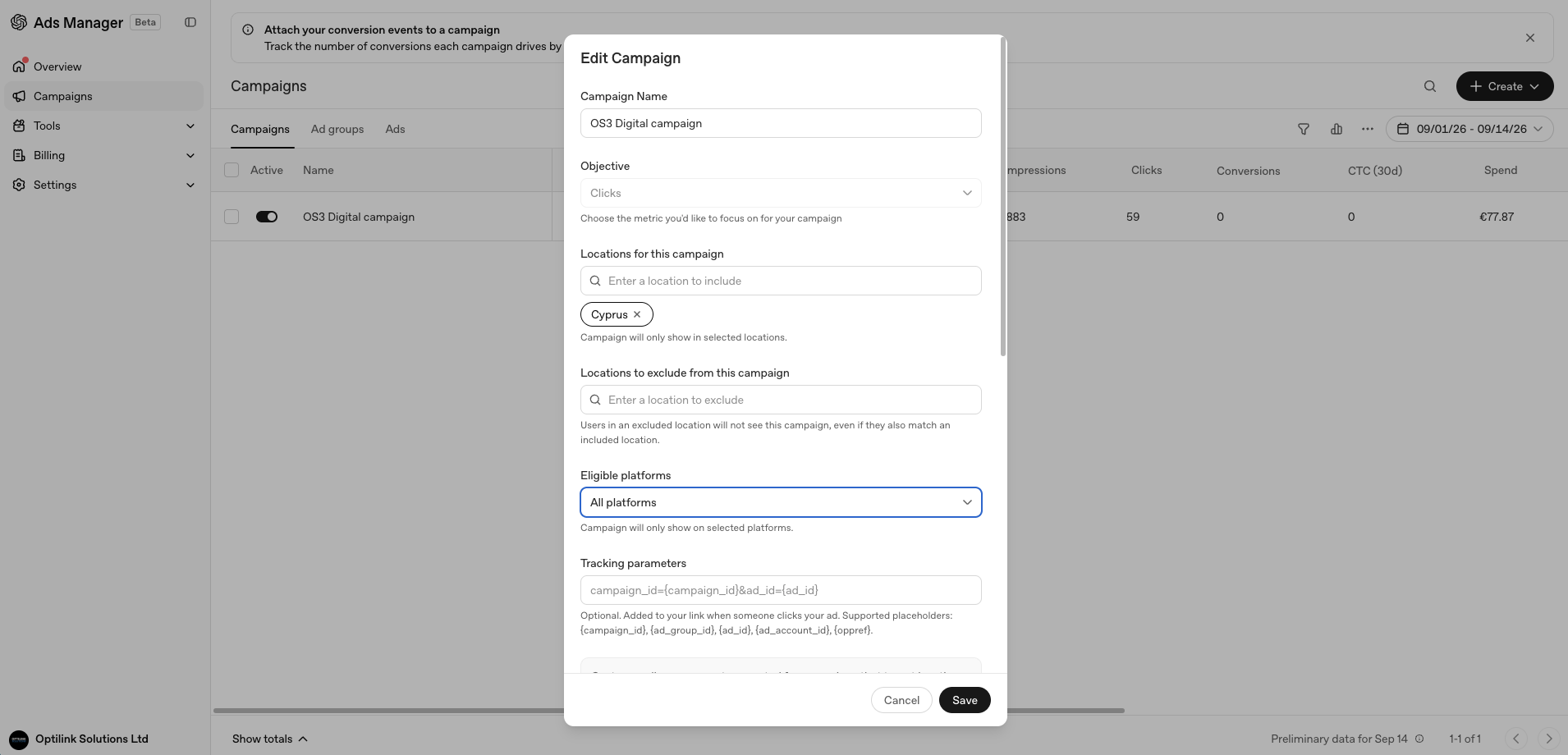
Conversion Tracking Is Already Part of the Platform
One of the areas we were particularly interested in testing was measurement.
OpenAI Ads Manager supports conversion events for actions that happen after someone interacts with an ad, including actions such as lead submissions, registrations and purchases.
Conversions can currently be measured through the OpenAI Pixel, Conversions API, or a combination of both.
For our own test campaign, we configured Lead Created as the conversion event.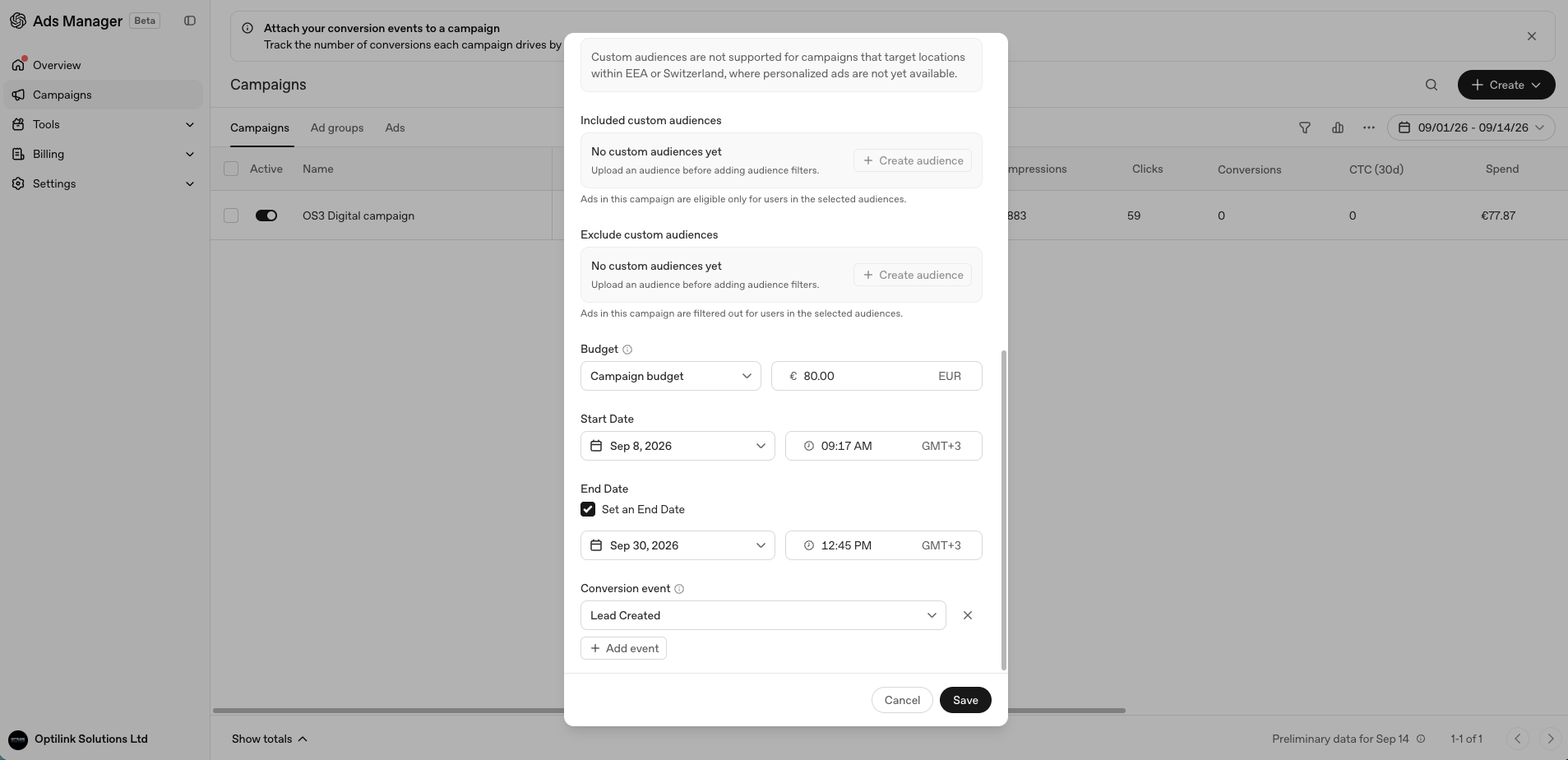
This is important because businesses shouldn’t evaluate a new advertising platform purely on impressions and clicks.
The real question is eventually going to be:
Can ChatGPT Ads generate meaningful business results at a competitive cost?
That’s exactly what we want to find out.
How ChatGPT Ads Differ From Traditional Digital Advertising
This is where things become interesting.
Google Ads has traditionally been built heavily around searches and keywords, while social advertising platforms such as Meta focus strongly on audiences, interests and user behaviour.
ChatGPT introduces another environment: the context of a conversation.
Within Ads Manager, advertisers can create ad groups and provide context hints describing the types of conversations that are relevant to their advertising.
That creates an interesting opportunity for businesses to appear while users are actively researching, comparing options or trying to make a decision.
The platform is still in beta, and it would be far too early to claim that ChatGPT Ads will outperform established channels such as Google or Meta.
But it represents a new type of advertising environment — and one worth testing.
What Can Advertisers Measure?
The reporting environment already provides many of the metrics digital advertisers will recognise.
OpenAI currently allows advertisers to monitor:
- Impressions
- Clicks
- Spend
- Click-through rate (CTR)
- Average CPC
- Average CPM
- Conversions when measurement is configured
Performance can be analysed at campaign, ad group and individual ad level.
For a platform this new, having familiar performance metrics makes testing and comparing results with other advertising channels considerably easier.
Our First Impression
It’s still early.
OpenAI itself describes Ads Manager as a Beta product, and additional functionality is expected as the platform develops.
But our first experience shows that ChatGPT Ads is already moving beyond an experimental advertising concept into something businesses can create, measure and optimise.
The interesting part now isn’t simply whether businesses can advertise on ChatGPT.
It’s understanding when it makes sense, which businesses benefit from it, what targeting strategies work and how the cost per result compares with established advertising platforms.
That’s what we’ll continue testing.
What’s Next for OS3 Digital?
Our first campaign is only the beginning.
We’ll continue testing different campaign structures, targeting approaches, messaging and conversion tracking to better understand how ChatGPT Ads perform specifically within the Cyprus market.
As more data becomes available, we’ll be sharing what we learn — including what works, what doesn’t and where we see genuine opportunities for businesses.
At OS3 Digital, our approach to new advertising platforms is simple:
Test first. Measure the results. Then build the strategy around the data.
ChatGPT Ads is new.
We’re already testing what’s possible.